Mount Sinai DigiTwin
Personalized, AI-Powered Health Optimization
The DigiTwin Project at the BioMedical Engineering and Imaging Institute (BMEII) and the Icahn School of Medicine at Mount Sinai is a broad program of research and development, at the intersection of rigorous clinical research and AI engineering. The program encompasses data collection studies, big data modeling to answer novel clinical questions, and research into novel AI-driven models of human health.
We’re pioneering the development of a Digital Twin Model, powered by AI and real-time health monitoring, trained to provide personalized insights to extend healthspan.

Transforming Healthcare: From Treating Illness to Improving Wellness
Today's healthcare system is more about treating illness than preventing it. It focuses on managing symptoms with medications, surgeries, and hospital visits—reacting only after problems arise. This approach, often called "sick care," leads to rising costs and a never-ending cycle of chronic disease management, without truly addressing the root causes of conditions like heart disease and diabetes.
We believe healthcare should be different. Instead of waiting for illness to develop, we need a proactive, personalized, and data-driven approach that helps people live longer, healthier lives.

A New Vision: Personalized, AI-Powered Health Optimization
We’re pioneering a Digital Twin Model, powered by Artificial Intelligence (AI) and real-time health monitoring, to extend healthspan—the number of years you live in good health. This revolutionary technology will use deep data insights to provide:
- Personalized Health Recommendations – AI-driven guidance tailored to your unique biology, lifestyle, and environment.
- Early Detection & Prevention – Identifying risks before disease develops, so you can take action sooner.
- Continuous, Adaptive Support – Dynamic recommendations that evolve with your health and goals.
Our approach is participatory (empowering you with actionable insights), preventive (catching issues early), and precision-driven (customized to your individual needs). This isn’t just about living longer—it’s about thriving.

How Digital Twins Revolutionize Health
Advancements in AI and Machine Learning (ML) now allow us to analyze massive amounts of data and create virtual health models, or Digital Twins. These models act as real-time simulations of your body, monitoring key health indicators and predicting risks with incredible accuracy.
Our two key objectives for Digital Twin technology in healthcare:
- Real-Time Health Tracking & AI-Powered Guidance – A digital health companion that provides expert-level insights into your well-being.
- Early Intervention for Preventive Care – Proactively identifying risks before symptoms appear, reducing the need for expensive treatments later.

A Next-Generation Whole-Body Digital Twin for Early, Disease-Agnostic Risk Detection
Our DigiTwin project is building a whole-body, disease-agnostic digital twin that detects early changes across all major systems—cardiovascular, metabolic, liver, kidney, brain, immune, and musculoskeletal—long before symptoms appear.
By integrating advanced imaging, multi-omics, wearables, and exposomic sensors, our Digital Twin model will be designed to continuously personalize prevention. AI-driven insights, real-time biomarker tracking, and predictive modeling enable more precise risk forecasts and earlier, more effective interventions tailored to each individual.

Redefining What It Means to Be Healthy
True health isn’t just about avoiding disease—it’s about actively shaping your well-being. Health is dynamic, influenced by lifestyle, environment, psychology, and biology. With a proactive, personalized approach, we can help individuals not only prevent disease but improve overall health outcomes and quality of life.
Putting it all together
Data is the key
Building advanced complex AI-driven models requires big data. The DigiTwin Project is utilizing large public-domain population health datasets to train AI models to recognize early markers of health trajectories.
To advance beyond the current state-of-the-art, the DigiTwin Project has embarked on assembling a large and comprehensive dataset of health biomarkers to enable even more precise and personalized health monitoring. The DigiTwin Study is a prospective longitudinal cohort study designed to collect health data spanning medical history, whole body MRI imaging, advanced genetic and multiomic analysis, data from wearable devices on activity and sleep, and at-home devices to collect data on exposure in the environment.
Once we have completed the DigiTwin study and assembled the DigiTwin cohort dataset, the next phase of the DigiTwin project will develop next-generation AI and ML modeling to interpret the data. Sophisticated machine learning analysis will perform individual phenotyping to discover novel insights into health at any one moment and trajectories in health markers over time – critical for meeting the objective of real-time health tracking and recognizing the signs for preventive intervention. Next, we will use AI to learn how lifestyle and health interact and develop models that provide personalized feedback to optimize the effect lifestyle has on health – meeting our objective to provide adaptable, expert-level guidance.
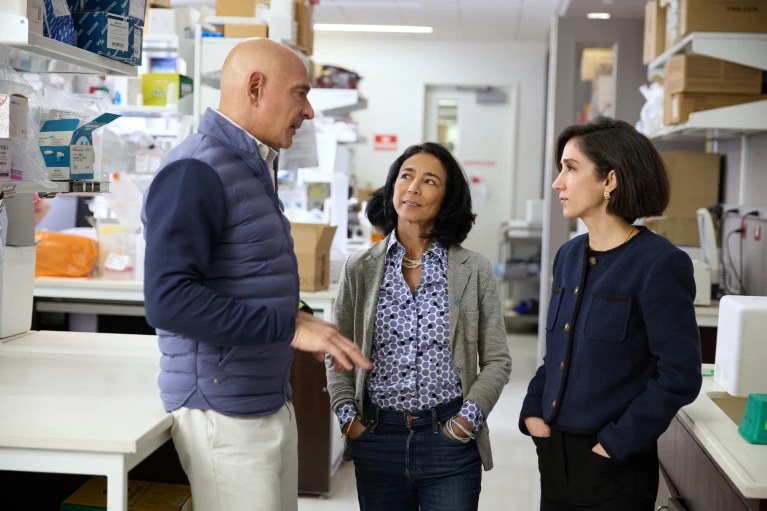
"Mount Sinai Researchers Featured in Nature for Advancing Healthspan Science"
Nature has published a sponsored feature highlighting Mount Sinai's leadership in redefining ageing through the XPRIZE Healthspan initiative. The article showcases the work of Drs. Miriam Merad, Zahi Fayad, and Fanny Elahi, who are pioneering new approaches to extend years of healthy living by integrating biology, lifestyle, and technology.
Read the full article on Nature's website here:
Healthspan research focuses on living healthier, not just longer
Support the DigiTwin Project
Your donation helps us transform healthcare through AI-powered digital twin technology.
In the donation form, please select "Other: DigiTwin" under "Direct my gift to".
Contact Us
Email: digitwin@mssm.edu
Direct questions to: Zahi Fayad and Todd Brooks